
Heard scratching in the walls at night? Found mouse droppings in a kitchen drawer?
Getting rid of mice in the house takes three jobs done together: cut off their food, seal every gap, and catch the ones already inside. Skip any one of those and a single female can reinfest the house with up to 60 pups in a year.
Here’s the easiest way to do all three steps properly so the mice don’t come back.
Step 1: Remove what’s feeding the mice
Start by checking the signs of mice in the house so you know which rooms to focus on.
Mice only need a few crumbs a day, so this step matters more than most people think. A hungry mouse is also much more likely to go for your traps.
Here’s what to do:
- Store dry food in mouse-proof containers. Cereal, flour, rice, pasta, oats, and pet food are the biggest attractants.[1] Thin plastic bags and soft plastic containers won’t stop a mouse. They can chew straight through them. Use glass, thick hard plastic, or metal containers with tight lids instead. Glass pantry containers
- Keep pet food locked up. Don’t leave bags of dog or cat food open in the garage or pantry. Pour what you need into a sealed container and put the rest away.
- Only put out what pets will finish. Leaving bowls of food out overnight is an easy free meal for mice.[1]
- Fix the trash. Use a bin with a tight-fitting lid.[1] If mice are getting into outdoor bins, move them away from the house or use a metal can.
- Clear clutter. Cardboard boxes, paper bags, and piles of fabric give mice both food scraps and nesting material.[1] Recycle or store things in sealed plastic totes.
Not sure what’s attracting them? Here’s why mice are in your house.
Step 2: Seal the gaps
Sealing is what stops new mice from walking in. A house mouse can squeeze through a gap only 1/4 inch (6 mm) tall, about the width of a pencil.[1] If you only trap and don’t seal, new mice will just keep coming in.
Here’s how to seal mouse holes properly:
1. Find the gaps first
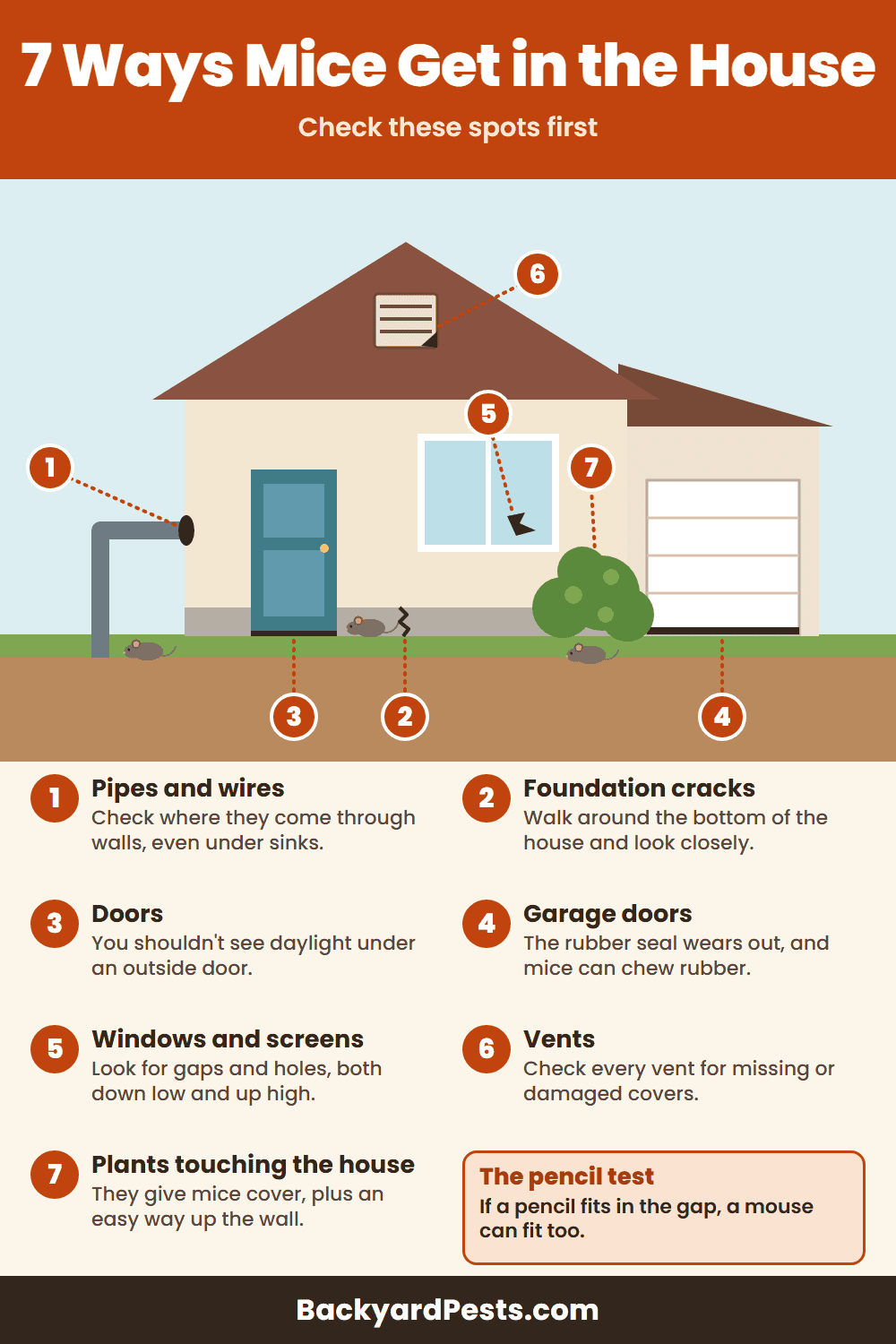
Walk around the outside and inside of the house looking for openings. Common entry points include:[1][2]
- Around pipes and wires under sinks
- Gaps under exterior doors
- Cracks in the foundation
- Openings around dryer vents, AC lines, and utility entries
- Holes in the garage or basement walls
- Places where siding meets the foundation
A good free test: if a pencil can fit in the gap, a mouse can too. Full checklist here: how mice get in the house.
2. Seal the gaps with materials mice can’t chew through
Mice will chew through expanding foam, rubber, plastic, and thin wood.[1][2] Use these instead:
- Small gaps (around pipes, wires, and cracks under 1/2 inch / 13 mm): Stuff with copper mesh or stainless steel wool, then cover with caulk or sealant.[2]
- Larger holes: Pack tightly with copper mesh or stainless steel wool, then seal over the top with caulk, mortar, or metal flashing.[2]
- Gaps under doors: Install a tight-fitting door sweep.[2]
- Vents: Cover with metal screening (not plastic).[1]
Recommended materials from Amazon:
- Xcluder stainless steel wool blend: easy to stuff into gaps
- Copper mesh roll: great for larger openings
- Door sweep
- Silicone or exterior-grade caulk (any good brand from the hardware store)
3. How to seal a typical gap
- Clean the area so the sealant will stick.
- Stuff copper mesh or steel wool tightly into the hole (mice can’t chew through it).[1]
- Cover it with caulk or sealant so it stays in place and looks neat.
- For gaps under doors, screw on a door sweep so there’s no daylight showing underneath.
Full details on what works and what doesn’t: what to use to seal mouse holes.
Do this step thoroughly. The University of California calls keeping mice out the most successful and permanent form of house mouse control.[1]
Step 3: Catch the mice already inside
Don’t wait this one out. Mice won’t leave on their own, they breed fast, and they can damage your home.
Snap traps are still the best mouse traps for most people. The University of California recommends them as the first step.[1]
Where to put mouse traps
- Along walls (mice rarely cross open floor)[1][2]
- Behind appliances, in cupboards, and in dark corners[1][2]
- Right next to mouse droppings or gnaw marks[2]
- Space them no more than about 10 feet (3 metres) apart in active areas[1][2]
- Use pairs of traps 1 to 2 inches (2.5 to 5 cm) apart for better odds[1]
Set more traps than you think you need. Nebraska Extension says roughly two dozen well-placed snap traps can handle a new mouse problem in a 1,500-square-foot (140 m2) home.[2]
Full placement guide: where to put mouse traps in the house.
Best baits: best bait for mouse traps.
| Method | Cost | Does it work? | The catch | Product |
|---|---|---|---|---|
| Live trap | Cheap | Catches mice, but doesn’t solve the problem | Releasing mice outside has real problems[1][2] | Not recommended |
| Snap trap | Cheap | Yes, the top pick[1] | You have to dispose of the mouse | Victor wooden snap traps |
| Electric trap | More expensive | Yes[1] | Needs batteries and regular checks[1] | Victor electronic mouse trap |
| Glue board | Cheap | Poor for adult mice[1] | Can catch pets and wildlife, and leaves the mouse alive and stuck[1][2] | Not recommended |
| Poison bait | Cheap | Slowly, and only as a last resort | Mouse poison puts kids, pets, and wildlife at risk[1][2] | Not recommended |
Skip the shortcuts. There’s no solid proof that peppermint oil repels mice, little evidence that ultrasonic pest repellers work, and a cat rarely solves a mouse problem.
Once the mice are gone, clean up carefully. Put on rubber or plastic gloves first, like these disposable nitrile gloves.[4] Spray mouse droppings with disinfectant until fully wet, wait 5 minutes, then wipe them up with paper towels. Never sweep or vacuum dry droppings.[4] Full safe cleanup steps: how to clean up mouse droppings.
Deer mice can spread hantavirus, so check whether you have a house mouse or a deer mouse first.[3]
What do I need to get rid of mice?
You don’t need much. Start with traps and something solid to seal the gaps.
- Victor wooden snap traps, 12-pack
- Victor electronic mouse trap, 2-pack, if you’d rather not handle a snap trap
- Xcluder stainless steel wool blend fill fabric for stuffing gaps
- Copper mesh roll for larger gaps
- Door sweep for gaps under outside doors
- Glass pantry containers for cereal, flour, rice, and pet food
- Disposable nitrile gloves, 100-pack for cleaning up droppings
As an Amazon Associate I earn from qualifying purchases.
When should I call a professional about mice?
Call someone in if you keep catching mice after a few weeks of sealing and trapping, or if you simply can’t find where they’re getting in.
Save this for later: pin this post so the three steps are here when you need them.
Sources:
[1] University of California Statewide IPM Program, Pest Notes: House Mouse
[2] University of Nebraska-Lincoln Extension, Controlling House Mice (G1105)
[3] US Centers for Disease Control and Prevention, About Hantavirus
[4] US Centers for Disease Control and Prevention, How to Clean Up After Rodents


